
Photographic Gear
What was it like taking rally and motorsport photos in the late 1970s?
A historical lament
Both cameras and people have changed a lot over time.
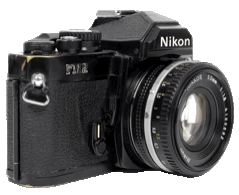
Nikon FM2 – Manual focus camera
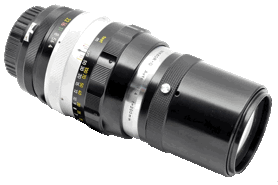
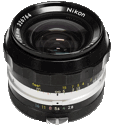
NIkkor 200mm f4 lens
NIkkor 24mm f2.8
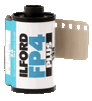
Ilford 125 ASA film
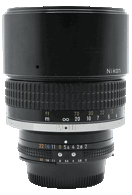
Nikon 135mm f2 lens
Focusing wasn't simple
All the fundamental camera functions have not changed in the last 45 years – focusing, exposure measurment, aperture and shutter speed settings. However, assistive technology that automates or makes it easier to take photos is the area that has come a long way in camera technology since 1978. But... when you are stuck in the 70s you have to deal with the gear that is available and learn to work within its limits.
For the cameras I used there was no autofocussing, so it was necessary to manually focus an image, rotating the lens ring so that a small split-screen element in the centre of the viewfinder aligned two parts of the image. That was fine in sunlight and for still objects. But car rallies mostly happened at night when you simply could not see the focusing element. One solution was to have a long tape measure, determine the distance to the subject and then set the camera lens to that distance, hoping that the driver has the same idea about their line through the
corner as you see in your plan. Or you could have a someone hold a torch on the right spot to focus and hope this will work.
Taking more photos
When a rally was held in daylight it was a huge relief. Focusing was much easier, but the daylight naturally offered the chance to take more than one photo through the corner. The technique used was to focus on the entry point to the corner, then on the middle of the corner and again on the exit as the car would move closer. The focussing action could then be rehearsed many times befre a car arrived so you could track the focusing to match the car's position. Of course the focusing action was interrupted by the need to manually crank the film advance lever between each shot. It still surprises me now how successfully that technique worked – not every time but enough – once it was ingrained into your muscle memory.
Favourite gear
I used only a small selection of lenses. My favourite was the 135mm f2 lens. The wide aperture lens allowed me to take photos even when the afternoon light dimmed, or it was raining. Its focal length helped to bring the car closer and still contained enough of the scene to provide context for the action in the photos.
As you can see on the page about the IMPACT OF FILM there has been some breathtaking advances in technology over a relatively short space of time. The colour photo was taken with a camera that automatically tracks the subject, keeping it in focus all the time and adjusting the exposure dynamically. The lens used, and indeed all modern lenses, are made to exacting standards and produce images far sharper than was ever possible in the 1970s.

THEN
NOW